This paper is one of the early roots of my semantic extraction work: event roles, domain adaptation, and the question of how much structure can be extracted from text without building a giant hand-engineered system. It uses domain-relevant word representations to identify event role fillers in MUC-4 news articles.
Research question
Event extraction systems usually need domain-specific knowledge, carefully designed features, and annotated data. That makes them expensive to build and annoying to move from one domain to another.
This paper asks whether event roles can be extracted using automatically learned, domain-relevant word representations instead of a large set of manually engineered linguistic features.
Main result
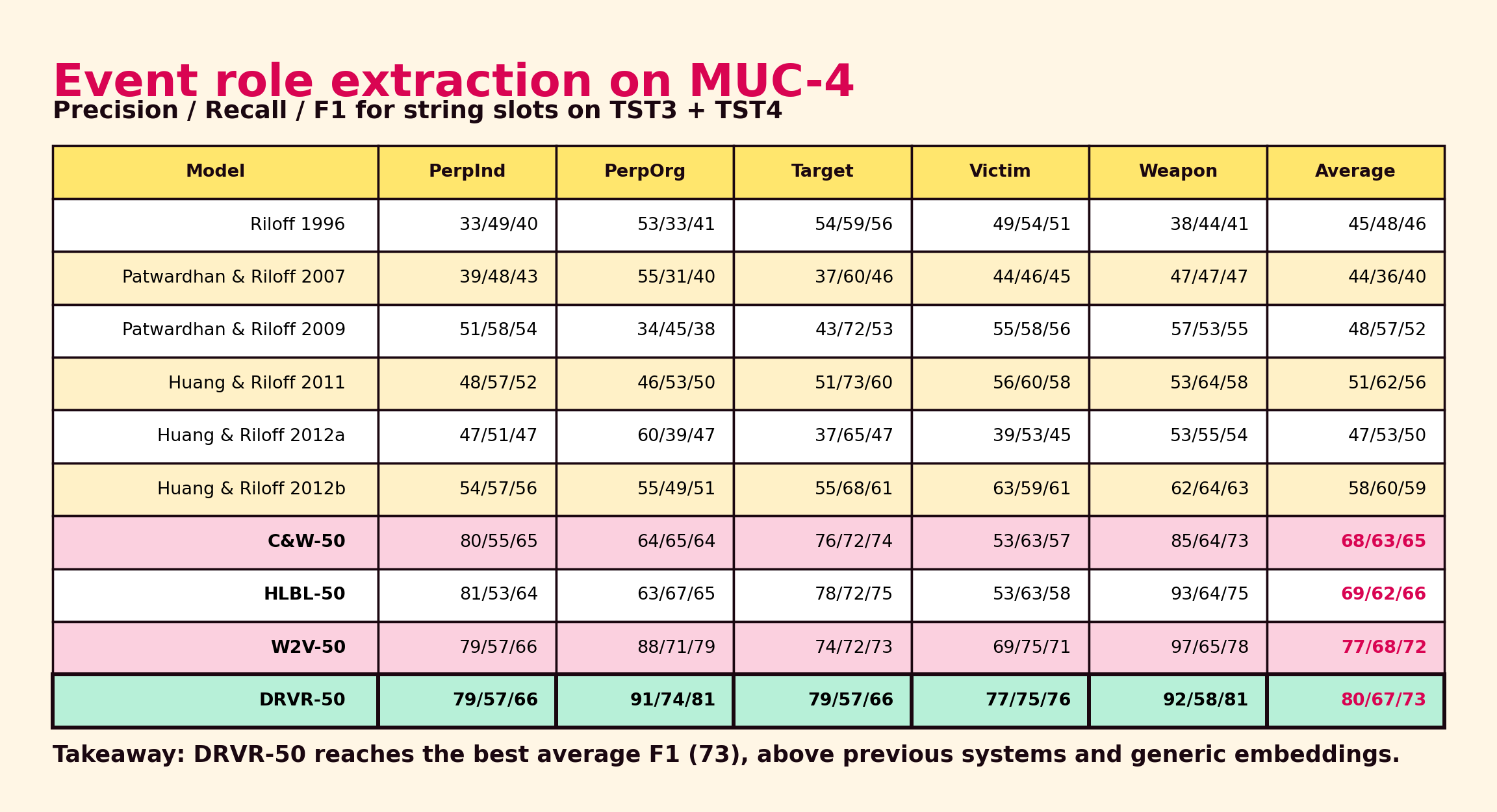
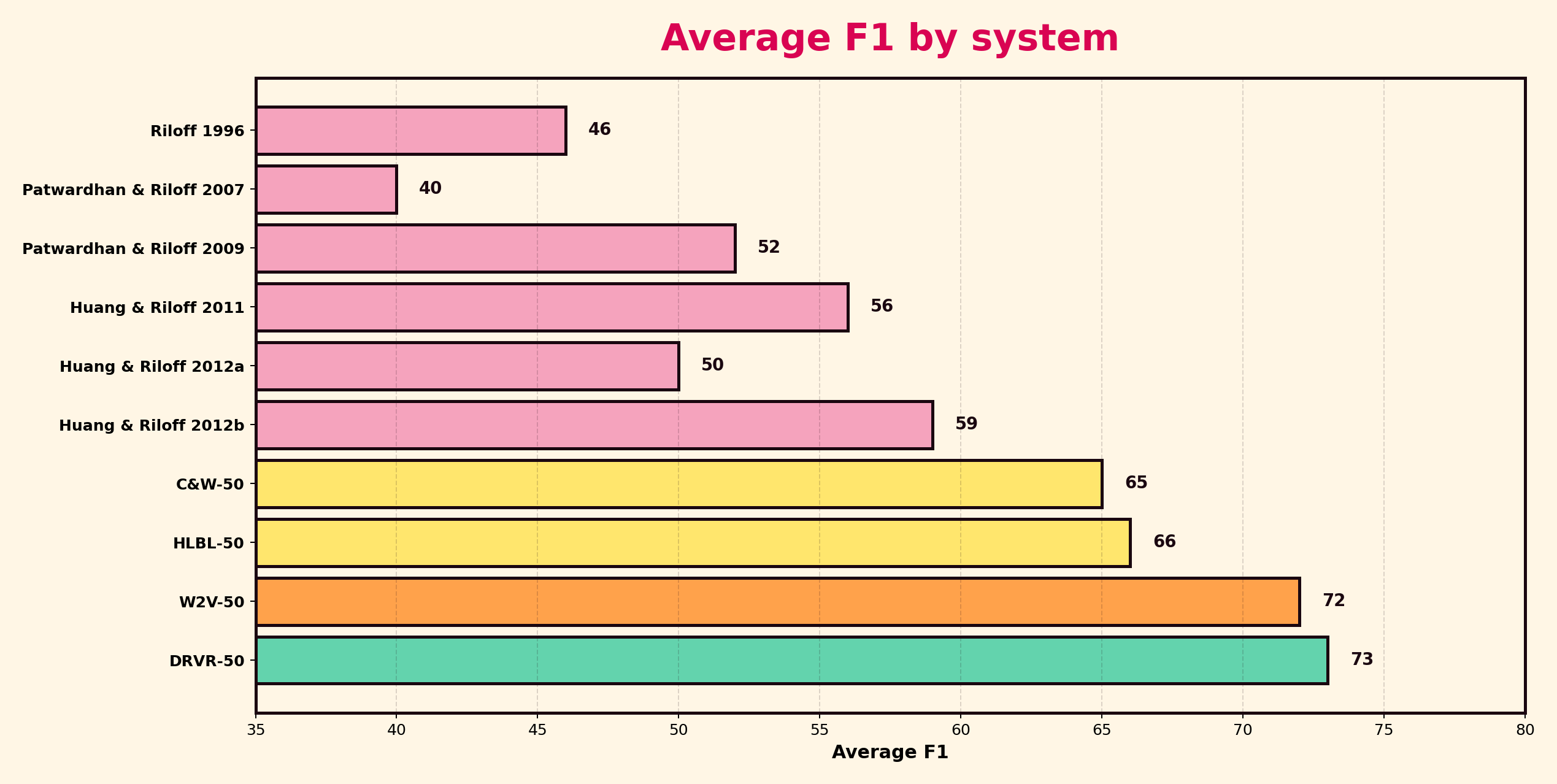
Domain-relevant vectors work surprisingly well. The DRVR-50 model reaches the best average F1 score on the MUC-4 string-slot task, outperforming previous state-of-the-art systems and generic embedding baselines.
The useful part is not only the score. It shows that compact semantic representations learned from domain text can carry enough information to identify event role fillers such as perpetrators, victims, targets, and weapons.
Method / experiment
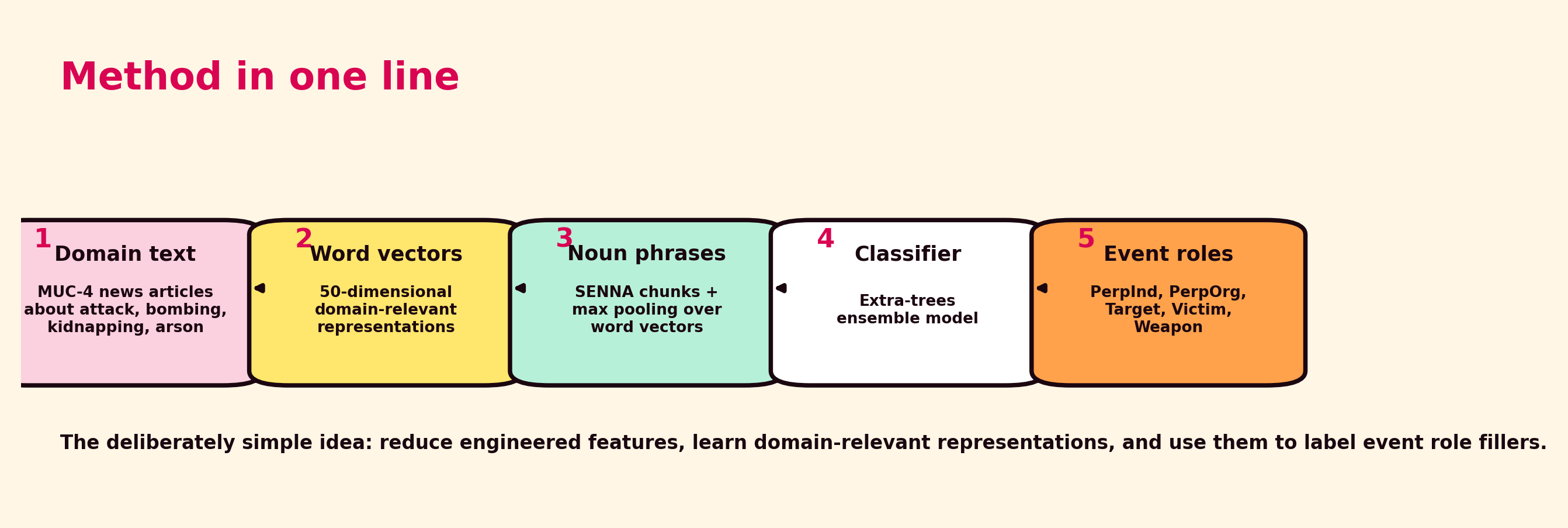
The method learns 50-dimensional word representations from domain-specific data. A small set of event seed words helps order the dictionary toward the event domain, rather than simply using word frequency.
Event role fillers are treated as noun phrases. The system extracts noun chunks, builds phrase representations by max-pooling the word vectors inside each chunk, and classifies them with an extra-trees ensemble classifier.
Experiments use the MUC-4 corpus: terrorist-event news articles with roles such as individual perpetrator, organization perpetrator, target, victim, and weapon.
Why it matters
This is an old paper, but the problem is not old. Domain adaptation is still the boring monster under the bed: models work nicely until the domain changes and the features stop being cute.
For my later work, this is one of the roots of semantic extraction: how to move from raw text to structured evidence while keeping the system less dependent on heavy feature engineering.
Reuse / links
Useful for work on event extraction, domain adaptation, semantic role-like extraction, low-feature NLP pipelines, and comparisons between generic and domain-specific representations.
Reuse idea: keep the extraction target structured, but reduce the amount of task-specific feature engineering by learning representations from domain text first.
One-line takeaway
Domain-relevant word representations can extract event roles better than older heavily engineered systems — and they are much easier to move around.