Research question
Historical language does not stay politely still. Names change, places drift, organizations appear and vanish, spellings move, and old documents arrive with OCR noise already attached.
The paper asks whether publication-year metadata can help Transformer-based NER models deal with this diachronic mess, and which temporal fusion strategy works best: early fusion, late fusion, absolute year encoding, or distance-from-present encoding.
Main result
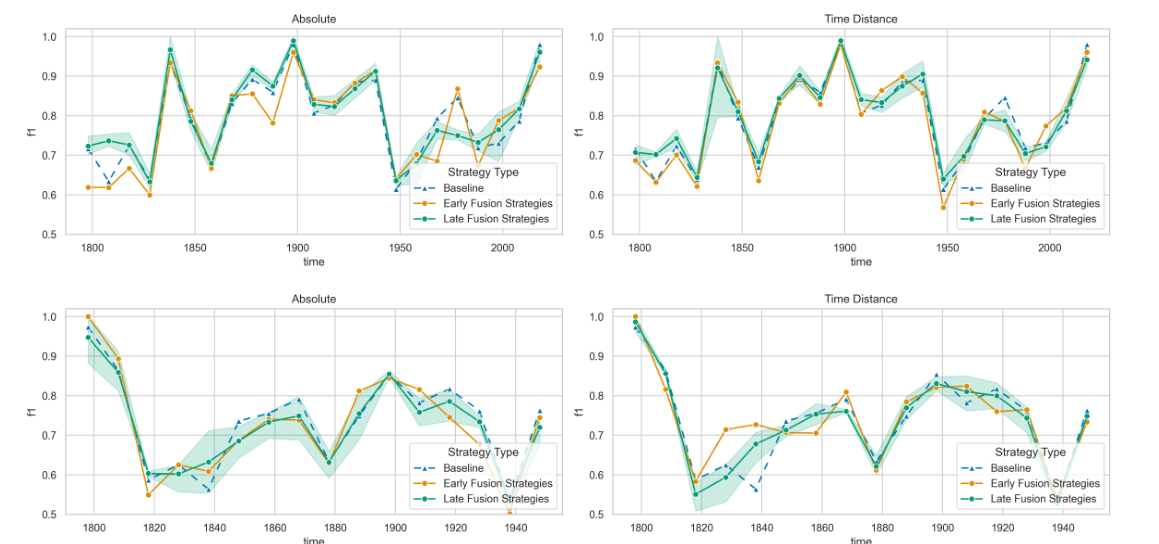
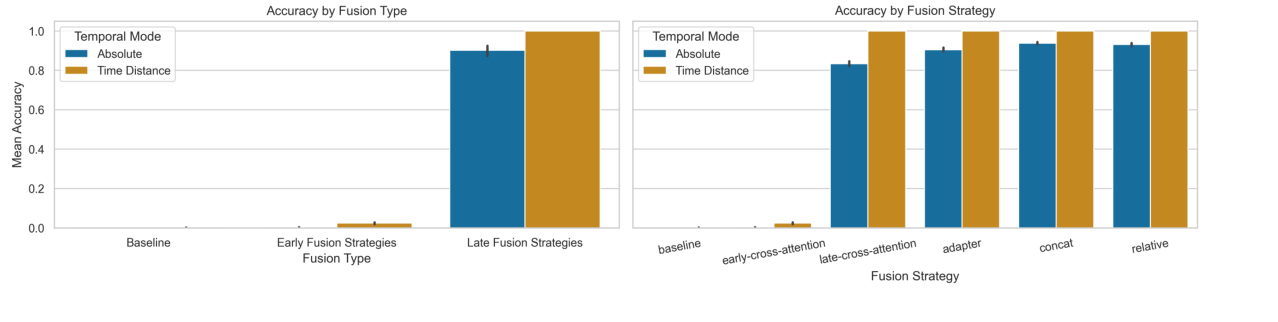
Late fusion strategies are the most robust. They usually perform better than early fusion and the baseline, especially in early or noisy periods where historical variation and OCR degradation make entity recognition harder.
The gains are modest, not fireworks, but they are consistent enough to be useful. Late cross-attention is the strongest candidate, with the clearest significant improvement over the baseline.
Method / experiment
The model is treated as a standard token classifier, but each document also carries a publication year. That year is embedded and fused with token representations using several strategies.
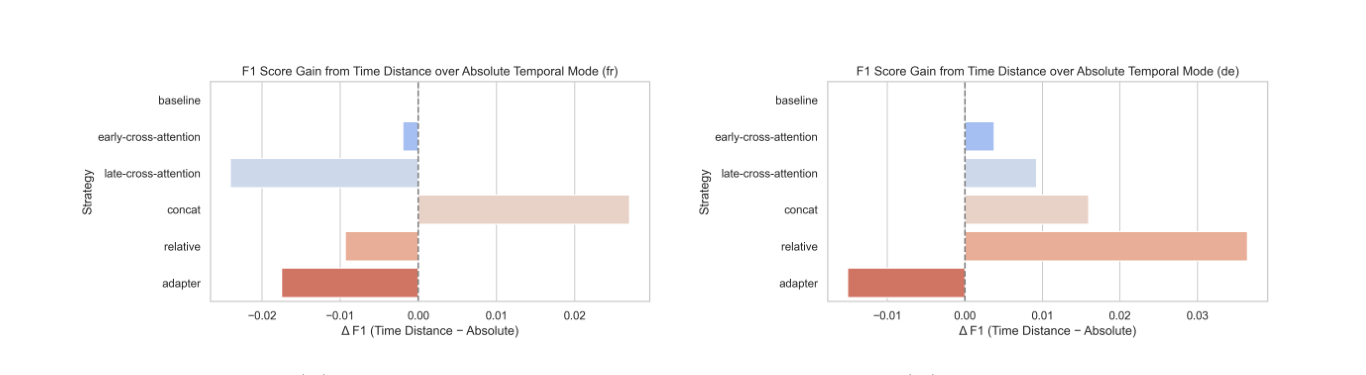
The study compares a baseline with no temporal fusion, early cross-attention, late adapter fusion, concatenation, relative temporal fusion, and late cross-attention. Each strategy is tested with absolute year embeddings and time-distance embeddings, where the year is represented as distance from 2025.
Experiments use the French and German subsets of a historical NER benchmark, covering long time spans and noisy OCR conditions.
Why it matters
Most NER models behave as if every document lives in the same flat present. That is convenient, and historically ridiculous.
This paper shows that even simple metadata — the year — can be structurally useful when it is injected in the right place. It matters for historical NLP because temporal drift is not a decorative problem; it changes what entities look like, how they are mentioned, and whether they are recognized at all.